EQUIP-IN – Study Plan
Over 60 months, from September 2025 to August 2030, we will work with you to explore and evaluate pathways for the assessment and provision of equipment and minor adaptations for older adults with difficulty bathing.
Study Plan
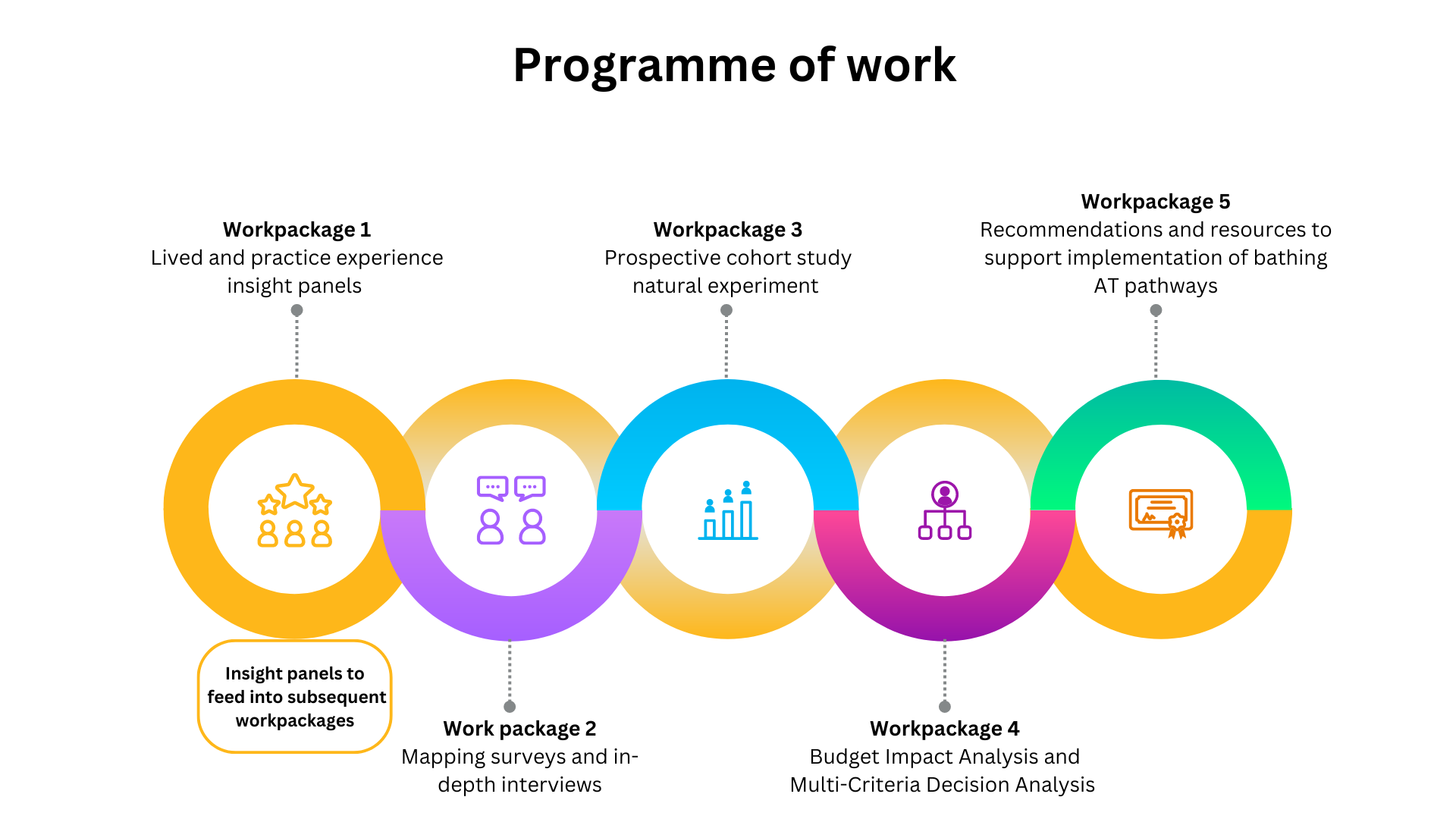
We’re working collaboratively with two insight panels – one panel of people with experience of using equipment and minor adaptations for bathing, and another panel of practitioners who support their use. Together we will design and carry out the following programme of work:
- We will map common pathways for older adults to access equipment and minor adaptations for bathing in up to 30 local authorities using a survey and workshops.
- We will interview older adults who are waiting for, have been offered, or provided with equipment and/or minor adaptations for bathing by adult social care services or who have paid for them themselves.
- We will conduct a cohort study which will compare outcomes and costs for people who had their equipment and minor adaptations provided within different timescales.
- We will use a statistical technique to combine this data with other studies.
- We will identify the priorities of people who use and provide equipment and minor adaptations for bathing to develop a tool to help local authorities to make decisions.
- We will test a theory about how new ways of working can be introduced into practice to create impactful change. This will inform interviews and workshops with people involved in assessing and providing equipment and minor adaptations.
- A PhD student will focus on the impact of equipment and minor adaptations for carers of older adults.
We will combine our findings from each stage of the research to make suggestions for the pathway of providing aids to older adults with difficulty bathing. We will work with our insight panels to share these findings with public, practice, policy and academic audiences. Find out about our impact.
Read more in our Plain English Summary (pdf 165 Kb)
Coming in 2027
Online Map
We’re currently researching traditional and innovative pathways to the provision of equipment and minor adaptations for bathing. We will use our findings to create a map of the process.